- By Saurabh Smar, Principal Solicitor, Global Vision Migration Lawyers
- 08 Oct, 2026
The queue is not your only option
Most families who come to us about bringing a parent to Australia have already been told the same thing: join the parent visa queue and wait. For many of them the wait is measured in decades, not years, and the person they are waiting for is already in their seventies.
The Sponsored Parent (Temporary) visa, subclass 870, exists for exactly this problem. It will not make anyone a permanent resident. What it does is let a parent live in Australia with their child for a continuous period of up to five years at a time, with multiple entries, while the longer questions stay on the table.
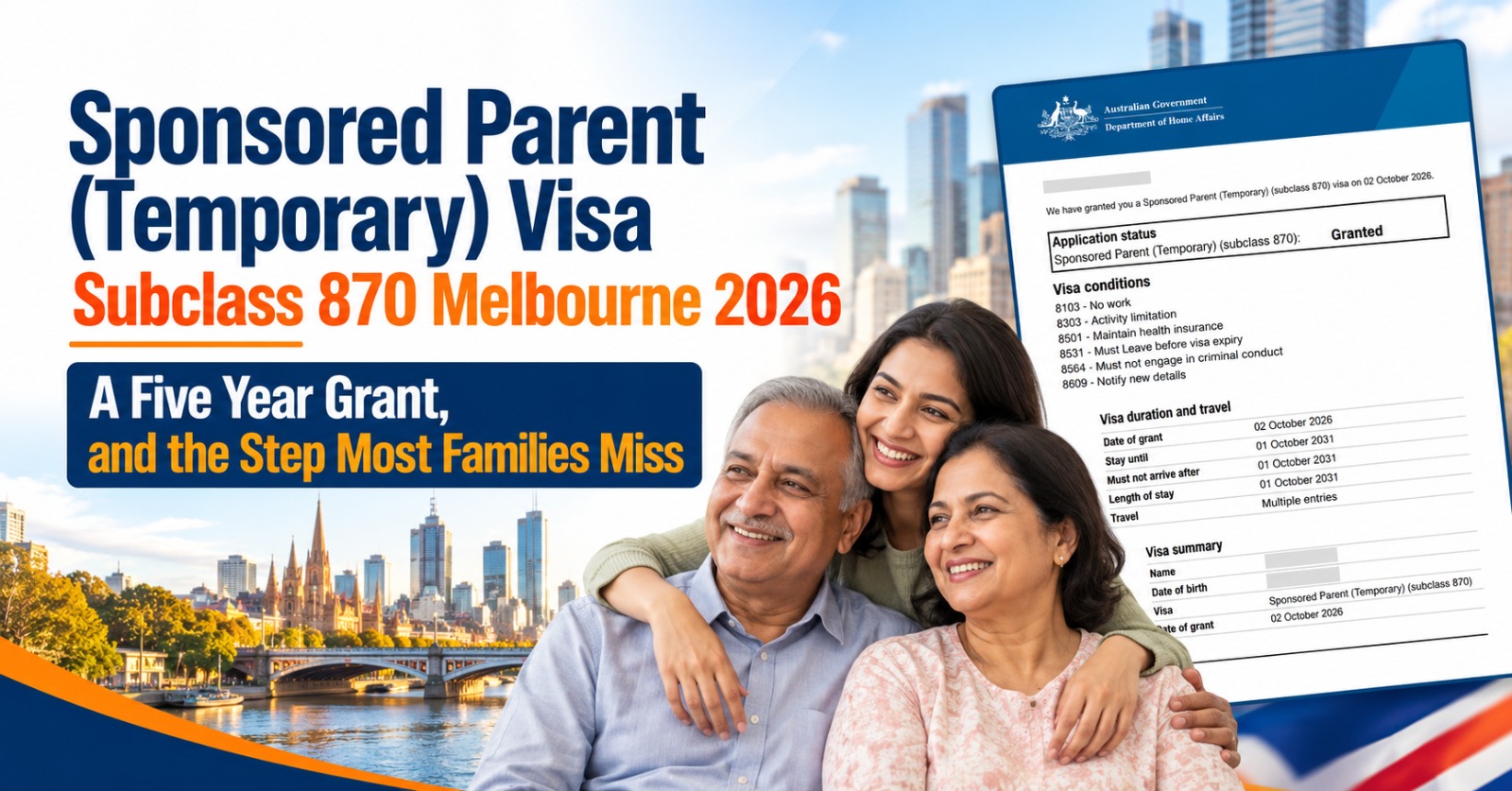
In October 2026 our office had a subclass 870 granted for a parent travelling on a Pakistani passport. The visa was granted for five years, to 1 October 2031, with multiple entry rights. This article explains how that visa works, what it allows and forbids, and where applications come unstuck.
What the subclass 870 actually gives a family
The subclass 870 is a temporary visa for the parent of an Australian citizen, an Australian permanent resident, or an eligible New Zealand citizen. The Department describes it as a way for parents to reunite temporarily with their children in Australia without taxpayers carrying additional cost, and that framing explains almost every condition attached to it.
A grant can be for up to three years or up to five years. The five year grant is the one most families want, and it is the one we see most often where the sponsorship has been prepared properly.
Unlike the permanent parent visas, the subclass 870 sits outside the capping and queuing arrangements that create those long waits. That single structural difference is why it is worth looking at seriously, even for families who are already in the permanent queue.
What it is not: a pathway to permanent residence. Holding a subclass 870, and holding it well, does not create an entitlement to anything further. Anyone who tells a family otherwise is selling them something.
Case Snapshot
The step most families miss: sponsorship comes first
This is the single most common reason a subclass 870 goes wrong, and it is worth stating plainly.
The subclass 870 is two applications, not one. The child in Australia must first apply to become an approved parent sponsor. Only once that sponsorship is approved can the parent lodge the visa application. Lodging them in the wrong order, or assuming the visa application carries the sponsorship with it, costs families months.
The sponsor must be the child of the applicant and must be an Australian citizen, an Australian permanent resident, or an eligible New Zealand citizen. The Department treats a parent as the biological parent, a legal parent including an adoptive parent, a step-parent, or a parent-in-law of the sponsor, so the relationship is wider than many people assume.
There is also an income test applied to the sponsorship. It is set by legislative instrument, the Migration (LIN 19/146: Income Test for Sponsorship for Temporary Sponsored Parent Visa) Instrument 2019, and it works off taxable income for a specified income year rather than off current earnings or a payslip.
The threshold figure is not something to take from a blog, including this one. Check the current figure against the instrument on the Federal Register of Legislation and against the Department of Home Affairs before you commit to a plan, because an income test applied to the wrong income year is the kind of error that is only discovered at decision stage.
The conditions, and what they mean in daily life
The grant we are drawing on carried six conditions. They are standard for this visa, and families should understand them before anyone books a flight.
Condition 8103 - no work. The holder cannot undertake work in Australia. Not part time, not cash, not helping in the family business. This is the condition most likely to be breached by accident and it is the one most likely to end a visa.
Condition 8501 - maintain health insurance. Adequate health insurance must be maintained for the whole stay. Reciprocal health care arrangements between Australia and another country may not be adequate for this purpose, and Pakistan has no reciprocal health care agreement with Australia, so a parent travelling on a Pakistani passport will need genuine private cover.
Condition 8531 - must leave before visa expiry. The holder cannot stay beyond the period permitted.
Condition 8303 - activity limitation. The holder must not become involved in activities disruptive to, or violence threatening harm to, the Australian community or a group within it.
Condition 8564 - must not engage in criminal conduct.
Condition 8609 - notify new details. Any change to name, address, phone number, email or passport must be notified within 14 days.
Condition 8501 deserves particular attention because it is continuing. It is not satisfied by buying a policy before the flight and forgetting it. A policy that lapses in year three of a five year visa is a condition breach, and a condition breach is a ground on which a visa can be cancelled.
Step by step
- Identify the sponsoring child and confirm they are an Australian citizen, permanent resident or eligible New Zealand citizen.
- Confirm the parental relationship and gather the civil documents, resolving any name inconsistencies.
- Establish taxable income for the income year the instrument specifies, with evidence the Department accepts.
- Lodge the parent sponsorship application and wait for approval.
- Once sponsorship is approved, lodge the subclass 870 visa application, choosing the three year or five year option.
- Complete health and character requirements, and arrange adequate health insurance.
- On grant, diarise the insurance renewal, the visa expiry, and the 14 day notification obligation.
Frequently asked questions
Can my parents work in Australia on a subclass 870 visa?
No. Condition 8103 prohibits work. This includes casual, part time and unpaid-looking work in a family business.
Does the subclass 870 lead to permanent residence?
No. It is a temporary visa. Holding it does not create an entitlement to a permanent parent visa, and time spent on it does not count towards citizenship.
How long can a parent stay?
A grant can be for up to three years or up to five years. There is a limit on how long a parent can hold these visas in total. Confirm the current limit with the Department of Home Affairs before planning successive applications, because planning a decade of a parent's life around a figure taken from a website is not sound.
Do I have to apply for sponsorship first?
Yes. The sponsorship must be approved before the visa application can be lodged.
Can both parents be included?
The subclass 870 is assessed per applicant. Families bringing both parents should plan both applications together, including the insurance and the income test, rather than treating the second as an afterthought.
What health insurance is required?
Adequate health insurance must be maintained for the whole stay under condition 8501. Reciprocal health care arrangements may not be adequate, and Pakistan does not have a reciprocal health care agreement with Australia.
What is the visa application charge?
Charges change and are set by regulation. Check the current charge on the Department of Home Affairs website rather than relying on a figure in an article.
What happens if the visa is refused?
A refusal may be reviewable by the Administrative Review Tribunal. Time limits for review are short and strict. If a refusal arrives, get advice immediately rather than after the deadline has passed.
Can my parent travel in and out?
The grant we have described carried multiple entry rights. Travel facility is set in the grant, so check the grant notice rather than assuming.
Speak to an Immigration Lawyer
Global Vision Migration Lawyers is an Australian immigration law firm with offices in Melbourne, Sydney, Canberra, the Gold Coast and Perth. Our practitioners are Australian legal practitioners, which means your matter is handled under the legal profession rules and, if a decision ever needs to be challenged, we can represent you at the Administrative Review Tribunal and in the courts.
Parent matters are rarely simple. They involve documents issued overseas, income evidence that has to match a specific income year, and families making decisions about where an elderly parent will spend the next five years. We work on complex family and employer sponsored matters, and we will tell you honestly at the outset whether the subclass 870 is the right instrument for your situation or whether something else fits better.
Call: 0449 889 900 | WhatsApp: 0430 081 804 | Email: migration@gvm.com.au