- By Saurabh Smar, Principal Solicitor, Global Vision Migration Lawyers
- 30 Sep, 2026
When Your Partner Studies in Australia, Can You Work?
Yes, here is the proof. Most people applying for an Australian Student visa focus on the primary applicant. What they miss is what the dependent spouse gets and, in this case, it was the right to work in Australia.
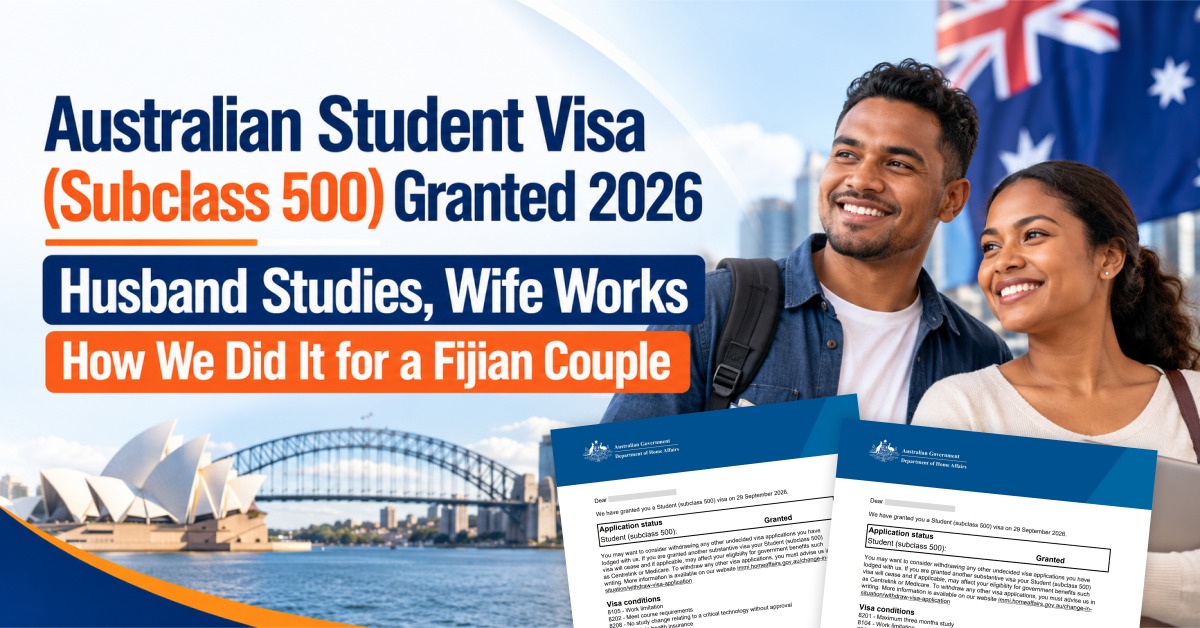
Global Vision Migration Lawyers recently secured Student (Subclass 500) visa grants for a husband and wife from Fiji. The husband is the primary student. His wife was granted her own Subclass 500 as a dependent, with work entitlements included.
Both visas were granted on 29 September 2026 and are valid until 15 March 2028. This article explains how it works, what determines the spouse's work rights, and what you need to get right before you apply.
Case Snapshot
What the Subclass 500 Student Visa Gives a Dependent Spouse
When a student visa holder includes their spouse as a secondary applicant, both receive a Subclass 500 visa. But the conditions on each visa differ, and those conditions determine what the spouse can do in Australia.
For spouses of students enrolled in a Masters or Doctoral degree, work is typically unrestricted. For other course levels, work limitations apply. The primary applicant's course level is the deciding factor.
The conditions on the dependent's visa are set at the time of grant. Changing the course afterwards can change those conditions, including the spouse's work rights.
Important
Always check the conditions listed on the visa grant letter. Do not assume that a course change will leave the dependent spouse's work rights unchanged.
The Genuine Student Requirement: What You Need to Know
Since November 2023, the Subclass 500 has been assessed against the Genuine Student (GS) requirement, replacing the former Genuine Temporary Entrant criterion.
Case officers assess whether the applicant's purpose is genuinely to study, whether the course is consistent with their background and goals, and whether they are likely to comply with visa conditions.
For applicants from Fiji and other Pacific nations, the assessment also considers the broader context of the applicant's circumstances, including their ties to their home country and their reasons for choosing Australia.
The personal statement is critical. It must be specific to the individual applicant and directly address the assessment criteria.
What Goes Into a Strong Application
- Confirmation of Enrolment (CoE). The primary applicant must be enrolled in a registered CRICOS course before lodgement.
- Relationship evidence. The Department assesses whether the relationship between the student and the dependent is genuine and ongoing. Marriage certificates, shared finances, communications, photographs, and statutory declarations all contribute.
- Financial evidence. Both applicants must demonstrate sufficient funds for tuition, living costs, and travel. Large unexplained deposits or funds held by third parties without explanation will be questioned.
- Health and character. Both applicants must satisfy health examination and character requirements before the visa can be granted.
- Genuine Student statement. It must be specific, credible, and directly responsive to the assessment criteria. It should not read like a template.
Mistakes That Lead to Refusal
- Choosing the wrong course level, which then restricts the spouse's work rights in ways the couple did not anticipate.
- A personal statement that does not specifically address the applicant's individual circumstances and reasons for studying in Australia.
- Financial evidence that shows a large recent deposit without explanation, or that does not meet the Department's published minimum thresholds.
- Thin relationship evidence for the dependent spouse - undated photographs, no joint financial records, and no statutory declarations from people who know the couple.
- Applying under outdated assumptions about the GTE framework, which was replaced by the GS requirement in November 2023.
Frequently Asked Questions
1. Can my spouse work in Australia on a dependent student visa?
It depends on the conditions attached to their visa, which are determined by the primary applicant's course level. Spouses of Masters and Doctoral students are typically not subject to work restrictions. Other course levels attract different conditions. Check your visa grant letter and seek legal advice if you are unsure.
2. Does my wife need a separate visa to come to Australia while I study?
No. An eligible spouse or de facto partner is included as a secondary applicant on the Subclass 500 application. Both receive their own Subclass 500 visa.
3. What is the Genuine Student requirement?
The GS requirement replaced the GTE criterion in November 2023. It requires the applicant to demonstrate that their purpose in coming to Australia is genuinely to study and that the proposed course is consistent with their circumstances and goals. Speak to an immigration lawyer about how to satisfy this requirement for your specific situation.
4. Can I change my course after the visa is granted?
Yes, but changes may affect your visa conditions and your dependent spouse's work rights. Get legal advice before making any changes.
5. What happens if my student visa is refused?
Some refusals can be reviewed at the Administrative Review Tribunal (ART). Time limits are strict. Contact a lawyer immediately after receiving a refusal.
6. How long does a student visa take to process?
Processing times vary. The Department publishes indicative timeframes on its website. A complete, well-prepared application processes faster than one requiring additional information.
Speak to an Immigration Lawyer About Your Current Visa Situation
If you are planning to study in Australia and want to bring your spouse, or if you want to understand what work rights your partner will have, the right time to get advice is before you enrol, not after you lodge.
At Global Vision Migration Lawyers, immigration lawyers, admitted legal practitioners, and consultants handle student visa applications, dependent spouse inclusions, Genuine Student statement preparation, and visa refusal reviews across Australia.
Call us on 0430 081 804 or visit gvm.com.au/book-a-consultation to book a consultation.
We are available across Melbourne, Sydney, Canberra, Perth, and the Gold Coast.